
Interview Questions and Answers for Call Center Jobs
The questions call center recruiters ask most, short sample answers you can adapt, how the mock call and typing test work, and what the official data says about pay and hiring.
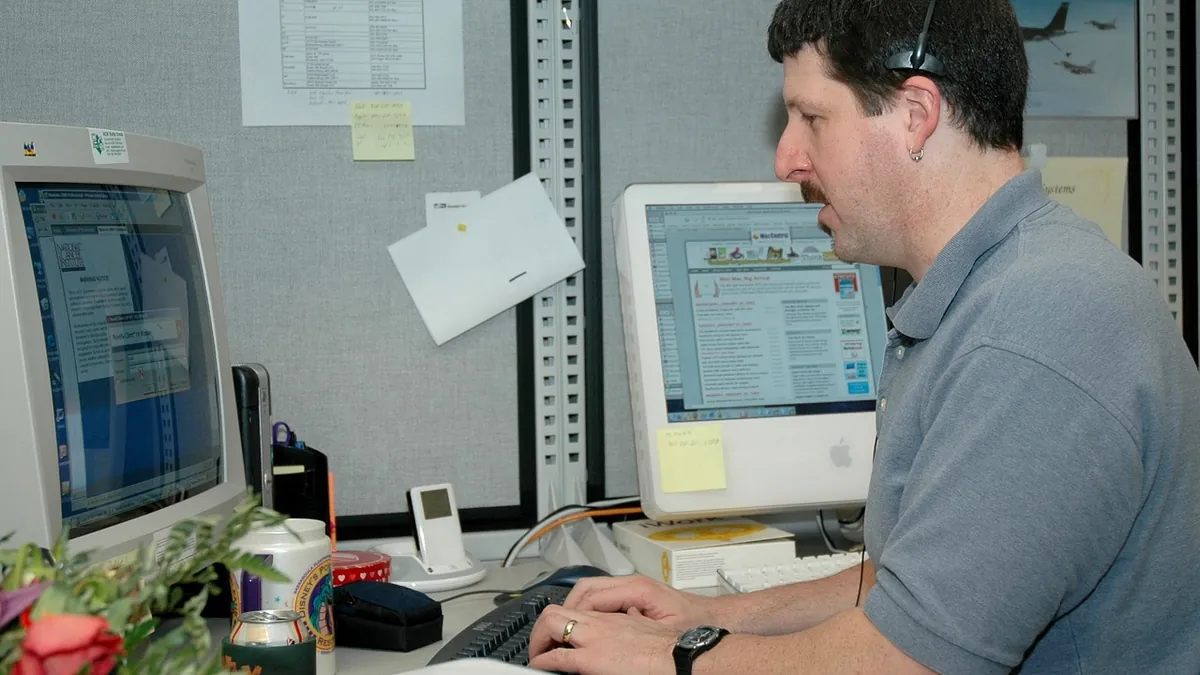
Most interview questions and answers for call center jobs test five things: how you communicate, how you listen, how patient you stay with upset callers, how you solve problems and how well you use computer systems. Prepare short answers with real examples for each, practise a mock call out loud and check your typing speed before the day.
Key facts
- The BLS lists communication, customer-service, interpersonal and listening skills and patience as important qualities for customer service representatives. (U.S. Bureau of Labor Statistics, Occupational Outlook Handbook, Customer Service Representatives, Aug 2026)
- US customer service representatives had a median pay of $44,770 a year ($21.53 an hour) in May 2025, with about 2,666,000 jobs and about 289,500 openings projected each year to 2035. (U.S. Bureau of Labor Statistics, Occupational Outlook Handbook, Customer Service Representatives, Aug 2026)
- The BLS notes that customer service representatives should have some experience using computers and usually receive short-term on-the-job training of 2 to 4 weeks. (U.S. Bureau of Labor Statistics, Occupational Outlook Handbook, Customer Service Representatives, Aug 2026)
- O*NET lists customer relationship management software among the technology used by customer service representatives and marks the occupation as Bright Outlook. (O*NET OnLine, Customer Service Representatives 43-4051.00, 2026)
- The US Department of Labor's soft skills curriculum names communication, enthusiasm and attitude, teamwork, networking, problem solving and critical thinking, and professionalism as six key areas. (U.S. Department of Labor, Training and Employment Notice No. 48-11, May 2012)
Good interview questions and answers for call center jobs all point to the same few skills. The recruiter wants to know if you can talk clearly, listen well, stay calm with an upset caller, fix the problem and use the computer system at the same time. This guide gives you the questions that come up most, short sample answers you can make your own, and a simple plan for the mock call and the typing test that many call centers add to the process.
The work is in steady demand. In the US there were about 2,666,000 customer service representative jobs in 2025, with a median pay of $44,770 a year, or $21.53 an hour. About 289,500 openings are projected each year to 2035, mostly as people move to other jobs or retire. That means many interviews, and a well prepared candidate stands out quickly.
What interview questions and answers for call center roles really test
The US Bureau of Labor Statistics lists five important qualities for customer service representatives: communication skills, customer-service skills, interpersonal skills, listening skills and patience. It also says representatives should have some experience using computers. Almost every question you hear maps to one of these. When you plan your answers, ask yourself which quality the question checks, then give one short, true example that proves it.
- Communication: can you explain things simply and politely?
- Listening: do you find the real problem before you answer?
- Patience: do you stay calm and kind under pressure?
- Problem solving: can you find a fix, or the right person who can?
- Systems: can you type, search and take notes while you talk?
The most common questions with sample answers
Use these sample answers as a model, not a script. Change every detail to match your own life. A recruiter hears the same memorised lines all day, so your real examples are what make you memorable.
1. Tell me about yourself.
Keep it to about one minute. Say what you do now, one or two strengths that fit the job and why you want this role. Sample: "I have worked at a busy pharmacy counter for two years, where I help 80 to 100 customers a day. I enjoy solving small problems quickly and I am comfortable on the till system and the phone. I want to move into a call center because I like helping people and I want to build a career in customer support."
2. Why do you want to work in a call center?
Show that you understand the job, including the hard parts. Sample: "I like talking to people and fixing problems, and I know the work is fast and needs focus. I want a role where I can learn a product well and get better each week, and where good results are measured clearly."
3. What does good customer service mean to you?
Sample: "It means the customer leaves with their problem solved, or with a clear next step and a time, and feels they were treated with respect. Being friendly matters, but being accurate and honest matters more."
4. How would you handle an angry caller?
This is the most important question in most call center interviews. Show a clear method. Sample: "First I let them finish without interrupting, because people calm down when they feel heard. Then I say sorry for the trouble, repeat the problem back to check I understood, and tell them exactly what I will do. If I cannot fix it myself, I explain who can and when they will hear back. I never take the anger personally."
5. Tell me about a time you solved a difficult problem for a customer.
Use the STAR method: situation, task, action and result. Sample: "A customer at my shop had been charged twice. I checked the receipt and the bank slip, called my supervisor to approve a refund, processed it while the customer waited and gave them the reference number. They thanked me and came back the next week."
6. How do you deal with stress and a long queue of calls?
Sample: "I focus on the call I am on, not the queue. I take short notes so I do not have to ask twice, and I use breaks to reset. After a hard call I take a breath before the next one so the next customer gets a fresh start."
7. How fast can you type, and which systems have you used?
Be honest and specific. Sample: "I type about 45 words per minute with good accuracy. I have used a point of sale system, email and spreadsheets, and I learn new software quickly." Check your speed with a free online test before the interview so the number you give is real.
8. What would you do if you did not know the answer to a question?
Sample: "I would never guess. I would tell the caller I will check, search the knowledge base or ask a team lead, and come back with the right answer. If it takes longer, I would agree on a callback time."
9. Are you comfortable with targets and call monitoring?
Sample: "Yes. Targets help me see if I am improving, and feedback from call reviews is the fastest way to learn. I would rather know what to change than guess."
10. Can you work shifts, weekends or nights?
Give a clear, true answer. If you have limits, say them politely and add what you can offer. A recruiter values honesty here because schedules are planned weeks ahead.
Behavioural questions and the STAR method
Behavioural questions start with "Tell me about a time". They are common because past actions are a good guide to future ones. Prepare four or five short stories from work, study, volunteering or family life, and practise telling each in under two minutes with the STAR shape.
- Tell me about a time you calmed an upset person.
- Tell me about a time you made a mistake and fixed it.
- Tell me about a time you worked as part of a team under pressure.
- Tell me about a time you explained something complex in simple words.
- Tell me about a time you went beyond what was asked.
Spend most of each answer on the action and the result. Say "I", not only "we", so the recruiter hears what you did. Where you can, add a number: customers served per day, a waiting time you cut, or a complaint you turned into a thank you.
The mock call or role play
Many call centers ask you to handle a short practice call with a recruiter playing the customer. They are not looking for perfect product knowledge. They want to hear a warm greeting, good questions, calm control and a clear close. Use this simple flow:
- Greet: say the company name, your name and offer help.
- Listen: let the customer explain without cutting in.
- Check: repeat the problem in your own words.
- Verify: ask for the details you need, such as an order number.
- Solve: explain the fix or the next step and a time frame.
- Close: ask if there is anything else and thank them.
Smile while you speak, because people can hear it in your voice. Keep a steady pace, use the caller's name once or twice and avoid words like "policy" without an explanation. If the role play customer gets angry on purpose, slow down and show empathy before you offer a solution.
Typing, listening and system tests
Some employers add short tests before or after the interview. Common ones include a typing test, a test of spelling and grammar for chat and email roles, a listening test with recorded calls and simple data entry tasks. Ask the recruiter what to expect so you can practise. The BLS notes that new representatives usually get short-term on-the-job training of 2 to 4 weeks, so employers mainly want to see that you can learn the system, not that you already know it.
O*NET lists customer relationship management software among the tools used in this work. If you have used any CRM, ticketing or booking system, mention it by name. If not, say which programs you do know and give an example of a tool you learned quickly.
Interview questions and answers in call center roles for freshers
If this is your first job, the recruiter knows you have no call center history. They want potential. Draw on school projects, part-time work, volunteering, sports teams or helping at a family business. Freshers often hear these questions:
- Why should we hire you without experience? Talk about your communication, reliability and how fast you learn, with one example.
- How do you handle criticism? Show that you take feedback calmly and act on it.
- What do you know about our company? Read the website and recent news, and name one product or service.
- Where do you see yourself in a few years? Mention growing into a senior agent, quality or trainer role.
For a strong first application, build a simple resume that puts skills and short examples first. The CV builder has clean, ATS-friendly layouts that work well for entry-level customer service roles.
Questions for experienced agents and team leads
If you already work in a contact center, expect deeper questions about results and coaching. Prepare real figures from your current role, but never share private company data.
- Which metrics did you track, and how did you improve them?
- How do you balance call time with quality?
- Tell me about a time you coached a new agent.
- How would you handle a team member who is often late?
- How do you keep morale up on a hard day?
Good answers show a plan, a result and what you learned. For a team lead role, talk about listening to calls, giving fair feedback, sharing best practice and caring for the wellbeing of the team.
Inbound, outbound, chat and technical support
Call center jobs differ, and recruiters will adapt their questions.
Inbound support
The focus is on solving problems and staying calm. Expect many questions about angry callers, accuracy and following procedures.
Outbound and sales
Expect questions about handling rejection, staying motivated and explaining value in a few words. Be ready to "sell" a simple item in a role play.
Chat and email
Written skills matter most. You may get a short writing test. Show that you can be clear, polite and correct, and that you can handle two or three chats at once.
Technical support
Expect basic questions about computers, internet connections or the product. Show a calm step by step method: ask, test, explain and confirm the fix.
Questions you should ask the interviewer
At the end you will usually hear, "Do you have any questions?" Always ask one or two. It shows interest and helps you decide if the job suits you.
- What does a typical day look like for a new agent?
- How long is the training, and what does it cover?
- How is performance measured and reviewed?
- What are the shift patterns, and how far ahead are they planned?
- What growth paths have people in this team followed?
Phone and video interview tips
The first round is often a phone call, which is a good test of how you sound to customers. Find a quiet place, use a headset if you have one, keep a glass of water close and have your resume in front of you. Stand up or sit straight, because it helps your voice sound clear and confident.
For video interviews, test the camera and microphone the day before, check your internet and choose a plain background. Look at the camera when you speak, not only at the screen. Close other apps so notifications do not distract you.
Common mistakes to avoid
- Giving long answers with no example.
- Speaking badly about a past employer or customers.
- Saying you never get stressed. Everyone does; show how you manage it.
- Guessing a typing speed or a system you have not used.
- Not asking any questions at the end.
- Arriving late or joining a video call late.
Your preparation checklist
- Read the job advert and list the skills it asks for.
- Write five short STAR stories that prove those skills.
- Practise the angry caller answer out loud.
- Do a mock call with a friend using the six-step flow.
- Check your typing speed and accuracy.
- Research the company and one product.
- Prepare two questions for the interviewer.
- Plan your travel or test your video setup.
The free interview prep tool gives you more practice questions and helps you plan answers for each skill.
What to wear and how to arrive
For an in-person interview, choose clean, neat and simple clothes that are one step smarter than what the team wears day to day. Arrive ten minutes early, bring a printed copy of your resume and a pen, and switch off your phone. Be polite to everyone you meet, from security to reception, because some recruiters ask them for their impression.
After the interview
Send a short thank you email on the same day. Thank the recruiter for their time, repeat one reason you want the job and add any detail you forgot. Keep it to a few lines. If you do not hear back by the date they gave, send one polite follow up. If the answer is no, ask for feedback. Many recruiters will share one or two points, and that helps you do better next time.
Pay and career growth
Pay depends on the country, the city, the shift and the type of work. In the US, the BLS reports a median pay of $44,770 a year for customer service representatives in May 2025. Technical support, specialist and bilingual roles may pay more, and night or weekend shifts sometimes add allowances. Check the advert and ask about pay structure if it is not clear.
A call center job can be the start of a long career. Common next steps include senior agent, quality analyst, trainer, team lead, workforce planner and customer success roles. The skills you build, such as clear communication, calm problem solving and comfort with systems, are useful in almost every industry.
Why these skills matter so much
The US Department of Labor's soft skills program names six key areas for workplace success: communication, enthusiasm and attitude, teamwork, networking, problem solving and critical thinking, and professionalism. A call center uses all six every day. When your interview answers show these skills with honest examples, you prove that you are ready for the job and ready to grow in it.
Practise a little each day in the week before your interview. Say your answers out loud, time them and make them shorter. On the day, breathe, smile and listen to each question fully before you answer. Calm, clear and honest is exactly what a call center recruiter hopes to hear.
Sample answers for tricky questions
Some questions feel like traps, but each one has a simple, honest answer.
What is your biggest weakness?
Pick a real weakness that is not central to the job, then show what you do about it. Sample: "I used to rush my notes when it was busy. Now I use short templates so my notes are complete without slowing me down."
Why did you leave your last job?
Stay positive and brief. Talk about what you want next, such as more training, a clearer career path or a better fit with your study hours.
How would you say no to a customer?
Sample: "I would explain the reason in simple words, say sorry that I cannot do what they asked and offer the best option I can give. People accept a no more easily when they also get a clear choice."
What would you do if a customer was rude to you?
Sample: "I would stay polite and calm and focus on the problem. If the caller became abusive, I would follow the company's procedure, which usually means giving a warning and asking a team lead for help."
Live on Dev Global Jobs
Right now there are 190,579 open jobs on Dev Global Jobs (live count, 26 October 2026). Practise more questions with the interview prep tool, then update your resume in the CV builder before you apply.
Frequently Asked Questions
What are the most common interview questions and answers for call center jobs?
Tell me about yourself, why you want this job, how you would handle an angry caller, a time you solved a hard problem, how you manage stress and what systems you have used. Answer each with a short, real example.
How do I answer how would you handle an angry customer?
Let the caller finish, say sorry for the trouble, repeat the problem to check you understood, explain what you will do and when, and ask a team lead for help if you cannot fix it yourself.
Do call centers give a typing test?
Some do, along with spelling, listening or data entry tests, especially for chat and email roles. Ask the recruiter what to expect and check your real speed with a free online test before the day.
Can I get a call center job with no experience?
Yes. The BLS notes that new representatives usually get 2 to 4 weeks of on-the-job training. Show communication, reliability and quick learning with examples from school, volunteering or part-time work.
How much do call center agents earn?
It depends on the country, shift and role. In the US the BLS reports a median pay of $44,770 a year ($21.53 an hour) for customer service representatives in May 2025.
What should I ask at the end of a call center interview?
Ask about a typical day, the length and content of training, how performance is measured, shift patterns and the growth paths people in the team have followed.
Sources
- Occupational Outlook Handbook, Customer Service Representatives, U.S. Bureau of Labor Statistics. Accessed 3 October 2026.
- Customer Service Representatives 43-4051.00, O*NET OnLine. Accessed 3 October 2026.
- Training and Employment Notice No. 48-11: Skills to Pay the Bills, U.S. Department of Labor. Accessed 3 October 2026.
- Interview advice, National Careers Service (UK). Accessed 3 October 2026.
- The STAR method, National Careers Service (UK). Accessed 3 October 2026.
- How to do well in video interviews, National Careers Service (UK). Accessed 3 October 2026.
Source: Dev Global Jobs, updated 26 October 2026.
Career Content Editor, Dev Global Jobs
Lutaf Ali is the Career Content Editor at Dev Global Jobs. He has written and edited our guides on jobs, CVs, visas, salaries and careers abroad since the site went live on 18 January 2026, and he runs our official social media. Every fact is checked against official and trusted sources, named in the post, and errors are corrected as soon as readers report them.
Lutaf Ali · About the editorial team · Editorial Policy
Lutaf Ali runs our social media. Follow Dev Global Jobs: Facebook · LinkedIn · Instagram · YouTube · X · Threads · Pinterest
Related Articles

Python Interview Questions and Answers
The Python questions interviewers ask most, with short, accurate answers and examples, from data types and mutability to generators, decorators, testing and live coding tips.
Read
Nurse Interview Questions and Answers
The questions nursing panels ask most, from clinical scenarios to patient safety and teamwork, with sample answers built on the STAR method and tips for new graduates and experienced nurses.
Read
Teacher Interview Questions and Answers PDF Guide
The questions school panels ask most, sample answers for new and experienced teachers, how to prepare a demonstration lesson, and how to save this guide as a printable PDF.
Read