
Work Application Cover Letter: Template and Examples
A free cover letter template, four worked examples and the structure that official career services in the UK, New Zealand and the US recommend.
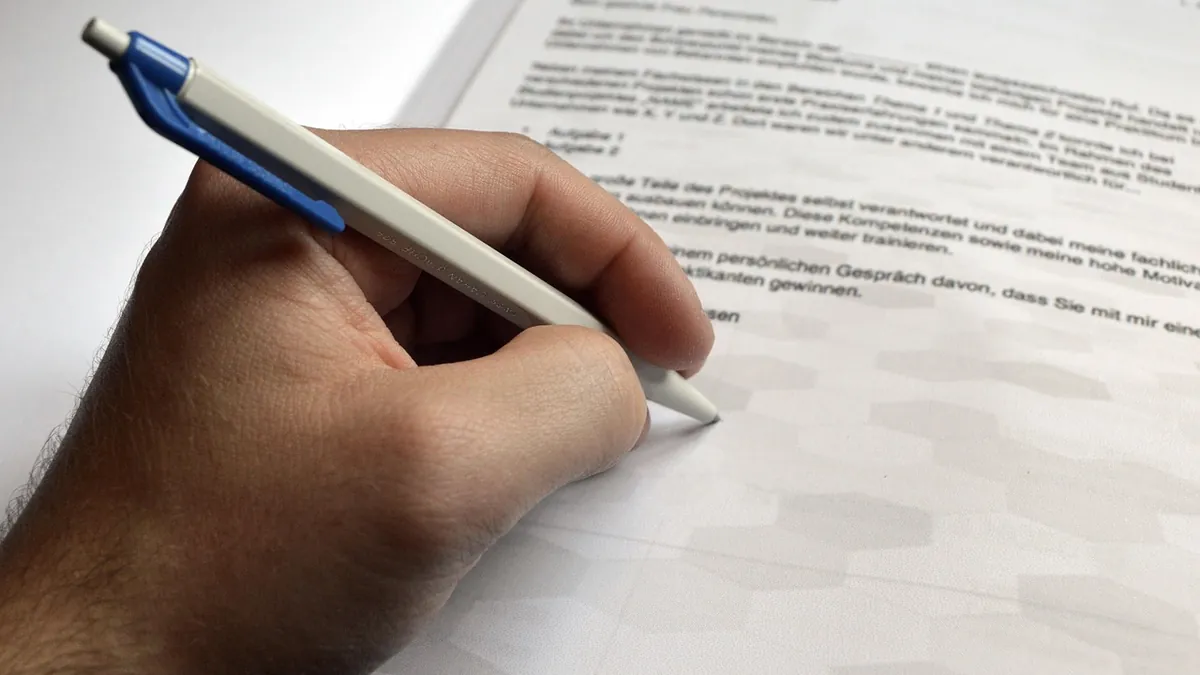
A good work application cover letter fits on one page, uses three to five short paragraphs and is written fresh for each job. Open with the role and why you want it, prove two or three matching achievements with numbers, show you know the employer, then close with a clear request for an interview.
Key facts
- A cover letter is usually 3 to 5 paragraphs long, and you should write a new one for every job you apply for. (National Careers Service (GOV.UK), How to write a cover letter, Oct 2026)
- Send a cover letter whenever you apply for a job with a CV, even if the advert does not ask for one. (National Careers Service (GOV.UK), How to write a cover letter, Oct 2026)
- Keep the letter to one page, use a plain font such as Calibri 11, short sentences, and send it as a PDF unless the employer asks for another format. (Tahatū Career Navigator (New Zealand Government), How to write a cover letter, Oct 2026)
- Focus the letter on one to three key achievements or skills that match the job description. (California Department of General Services, Cover Letter Tips, Oct 2026)
- Australian Public Service agencies commonly ask for a written pitch of 500 to 700 words instead of a standard cover letter. (Australian Public Service Commission, Cracking the code, Oct 2026)
- The free Europass cover letter editor lets you create and store cover letters in 31 languages. (Europass (European Union), Create your Europass Cover Letter, Oct 2026)
Your CV lists what you have done. Your cover letter explains why that makes you the right person for this one job. Recruiters often read the letter first to decide whether the CV deserves a closer look, so a weak letter can sink a strong CV. This guide shows you how to write a work application cover letter that is short, specific and easy to read, with a free template you can copy and four worked examples.
The advice follows what official career services recommend. The National Careers Service in England says a cover letter is usually three to five paragraphs and that you should write a new one for every application. New Zealand's Tahatū service advises one page at most, a plain font and short sentences. The California Department of General Services tells applicants to focus on one to three achievements that match the job. We combine these into one simple method that works in most countries.
What a cover letter is for
A cover letter is a short business letter that goes with your CV. It has three jobs. First, it tells the employer which role you want and how you found it. Second, it connects your experience to the requirements in the job advert, so the reader does not have to work it out. Third, it shows that you know something about the employer and actually want to work there.
A CV is a record. A cover letter is an argument. If you remember that difference, you will stop copying lines from your CV and start writing sentences that persuade.
Do you need one if the advert does not ask?
Usually, yes. The National Careers Service advises including a cover letter whenever you apply with a CV. The only exceptions are online forms that give you no place to attach one, and adverts that say clearly not to send one. When a form has a free text box called something like "supporting statement" or "why do you want this job", that box is your cover letter, so write it with the same care.
How long a cover letter should be
One page is the safe rule in most countries. That is roughly 250 to 400 words in a normal font size, split into three to five paragraphs. Some employers set their own rules, and you must follow them. Australian Public Service agencies, for example, often ask for a written pitch of 500 to 700 words against the job criteria instead of a classic letter. If an advert gives a word or page limit, treat it as a hard limit.
Short does not mean thin. Every sentence should either name a requirement of the job or prove that you meet it. Cut anything that does neither.
The structure of a work application cover letter
Use this order. It matches the advice of the official services above and it is easy for a busy reader to scan.
- Header. Your name, phone number, email address and city. Then the date, the hiring manager's name and title if you know it, the company name and its address or city.
- Greeting. Use the person's name: "Dear Ms Okafor". If you cannot find a name, use "Dear Hiring Manager" or "Dear Recruitment Team". Avoid "To whom it may concern", which sounds cold.
- Opening paragraph. Name the job title, the reference number if there is one, and where you saw it. Add one sentence that says why you want this role at this employer.
- Middle paragraph or two. Pick the two or three requirements that matter most in the advert. For each one, give a short example from your experience with a result, ideally a number.
- Employer paragraph. Show that you have researched the organisation: a project, a value, a product or a recent change, and how you would contribute.
- Closing paragraph. Thank the reader, mention that your CV is attached, say that you would welcome an interview and confirm your contact details.
- Sign off. "Kind regards" or "Yours sincerely", followed by your full name.
Cover letter template you can copy
Replace every part in square brackets. Delete any line that does not apply to you. Keep the final letter on one page.
[Your full name]
[Phone] | [Email] | [City, Country][Date]
[Hiring manager's name]
[Job title of the hiring manager]
[Company name]
[City]Dear [Ms or Mr Surname, or Hiring Manager],
I am applying for the [job title] role (reference [number]) that I saw on [website or source]. [One sentence on why this role at this company appeals to you, based on something specific you learned about them.]
In my current role as [your job title] at [employer], I [achievement that matches the first key requirement, with a number]. I also [achievement that matches the second requirement, with a result]. These are the same skills your advert asks for in [quote or paraphrase the requirement].
[Optional second example paragraph: a project, a qualification or a situation that proves a third requirement.]
I have followed [company]'s work on [project, product or value], and I would like to help with [specific goal or challenge]. [One sentence on what you would bring to that.]
Thank you for considering my application. My CV is attached, and I would welcome the chance to discuss the role in an interview. You can reach me on [phone] or [email].
Kind regards,
[Your full name]
You can also build a tailored letter with our cover letter tool, which asks for the job advert and your key achievements and drafts a first version for you to edit.
How to tailor a cover letter for a job in 20 minutes
Tailoring is what turns a generic letter into a strong one. You do not need hours. Follow this routine for every application.
- Highlight the advert (5 minutes). Mark the main duties and every required skill, qualification and experience. Circle the words that appear more than once. Those are the employer's priorities.
- Match your evidence (5 minutes). For the top three priorities, write one example each from your work, studies or volunteering. Use the STAR order the National Careers Service recommends: situation, task, action, result.
- Research the employer (5 minutes). Read the About page, a recent news item and the job's team page if there is one. Find one specific thing to mention.
- Write and trim (5 minutes). Drop your examples into the template, then cut any sentence that does not match a requirement. Read the letter aloud once.
Use the same words as the advert where they are true for you. Many employers sort applications by keyword before a person reads them, and matching language also makes it easy for the human reader to tick boxes.
Four cover letter examples
The four letters below are examples written for this guide. The names, employers and figures are invented to show the method, not taken from real applications.
Example 1: experienced professional
Dear Mr Hendricks,
I am applying for the Logistics Coordinator role (reference LC-204) advertised on Dev Global Jobs. Your plan to open a second distribution centre next year is exactly the kind of growth I want to be part of.
At Harbourline Freight I schedule around 120 deliveries a week across three depots. Last year I introduced a shared booking calendar that cut missed slots from 14 to 3 a month. I also trained six new dispatchers, which your advert lists as part of this role.
Your focus on lower empty-mile rates matches work I already do: I built a weekly report that helped our team combine part loads and reduce empty runs by about a tenth.
Thank you for your time. My CV is attached, and I would welcome an interview at your convenience.
Kind regards,
Daniel Mensah
Example 2: graduate with little experience
Dear Recruitment Team,
I would like to apply for the Junior Data Analyst position listed on your careers page. I graduate in economics this July, and your public dashboards on regional prices are what first made me interested in analytics.
For my final year project I cleaned and analysed 40,000 rows of household survey data in Python and presented the results to my department. During a summer internship at a local council I built a spreadsheet model that the housing team still uses to track repair requests.
I am comfortable with SQL, Excel and basic Python, and I learn new tools quickly. I would value the chance to grow within a team that publishes its work openly.
Thank you for considering my application. My CV and project link are attached.
Yours sincerely,
Priya Nair
Example 3: career changer
Dear Ms Lindqvist,
I am applying for the Customer Success Associate role. After six years as a primary school teacher I am moving into customer success, and your company's teaching software is a product I have used daily in my classroom.
Teaching taught me to explain complex ideas simply, manage 30 people with different needs at once and track progress with data. I introduced your platform to five colleagues and ran their training sessions, and our school's weekly use rose from two classes to eight.
I have completed a certificate in customer success management and set up help guides for parents at my school. I would bring a user's view to your team, and I understand the pressures teachers face when software does not work as expected.
Thank you for reading my application. I would be glad to talk about how my classroom experience could help your customers.
Kind regards,
Tomás Rivera
Example 4: internal application
Dear Ms Adeyemi,
I am applying for the Team Leader position in Accounts Payable. I have worked in the team for three years and I would like to take on more responsibility for its results.
Since joining, I have processed an average of 600 invoices a month with an error rate below 1 percent. When our supervisor was on leave last spring, I covered the daily allocation of work for five colleagues and kept us within our payment deadlines.
I know our systems and suppliers well, and I have ideas to shorten our month-end close, which I would be happy to share in an interview.
Thank you for your consideration.
Kind regards,
Lena Kovač
Formatting and sending your letter
| Item | Recommended choice |
|---|---|
| Length | One page, three to five paragraphs, unless the employer sets a limit |
| Font | A plain font such as Calibri, Arial or Helvetica, size 11 or 12, the same as your CV |
| Margins | Normal margins of about 2 to 2.5 cm, with space between paragraphs |
| File type | PDF unless the advert asks for Word |
| File name | Firstname-Lastname-Cover-Letter-Job-Title.pdf |
| Email applications | Put a short version in the email body and attach the full letter and CV |
| Language | The language of the advert; the free Europass editor supports 31 languages |
Common cover letter mistakes
- Sending the same letter to every employer. Recruiters notice generic letters at once. Change at least the opening, the examples and the employer paragraph each time.
- Repeating the CV line by line. Pick the few achievements that match this job and explain them.
- Talking only about what you want. Show what you can do for the employer.
- Wrong names. Check the company name, the hiring manager's name and the job title. A wrong name is the fastest way to the rejection pile.
- No numbers. Results such as "cut errors by a third" or "served 60 customers a day" are more convincing than adjectives.
- Typos. Read the letter aloud, then ask someone else to read it.
- Writing two pages. Unless the employer asks for more, a longer letter is less likely to be read in full.
Job cover letter application checklist
Use this job cover letter application checklist before you press send.
- The letter names the exact job title and reference number.
- The greeting uses a real name, or Hiring Manager if none is available.
- The first paragraph says why you want this role at this employer.
- Two or three examples match the top requirements of the advert, each with a result.
- One paragraph shows real knowledge of the employer.
- The letter fits on one page and uses the same font as your CV.
- All names and details are correct, with no spelling mistakes.
- The file is a PDF with a clear file name, unless the advert asks for another format.
Cover letters in different countries
The basics above work almost everywhere, but some local habits are worth knowing. In the United Kingdom and Ireland, a one-page letter with a CV is standard for most private sector roles. In Australia, many government jobs ask for a pitch against selection criteria rather than a classic letter. In Germany, application packs are formal and often include the cover letter, a CV and copies of certificates, so check each advert carefully. In the United States, many online systems make the letter optional, but a tailored letter still helps when a person reviews your file. For jobs in Europe, the Europass cover letter editor helps you prepare a clear letter in the language of the advert.
If you are applying for work abroad, explain your right to work or your visa situation in one short sentence near the end, so the employer does not have to guess.
Live on Dev Global Jobs
Right now there are 240,592 open jobs on Dev Global Jobs (live count, 21 October 2026), so there is plenty to practise on. Pick three adverts that fit you, tailor one letter for each with the 20 minute routine above, and compare how different each letter becomes. Create your CV to match in the CV builder, then browse all open jobs and save a job alert so new roles reach you first.
Frequently Asked Questions
What should a work application cover letter include?
Your contact details, the employer's details, a personal greeting, an opening that names the job, two or three examples that match the advert with results, a paragraph about the employer and a closing that asks for an interview.
How long should a cover letter for a job be?
One page is the safe rule, usually three to five paragraphs or about 250 to 400 words. If the employer sets a word or page limit, follow it exactly.
Do I need a cover letter if the job advert does not ask for one?
In most cases yes. England's National Careers Service advises sending a cover letter whenever you apply with a CV, unless the advert says not to or the online form gives you no way to attach one.
Can I use the same cover letter for every job?
You can reuse the structure, but rewrite the opening, the examples and the employer paragraph for each job. Official career services advise writing a new letter for every application.
How do I start a cover letter if I do not know the hiring manager's name?
Use "Dear Hiring Manager" or "Dear Recruitment Team". First check the advert, the company website and professional networks for a name, because a named greeting reads better.
Should I send my cover letter as a PDF or a Word file?
Send a PDF unless the employer asks for Word. A PDF keeps your layout the same on every device. Use a clear file name with your name and the job title.
Sources
- How to write a cover letter, National Careers Service (GOV.UK). Accessed 3 October 2026.
- How to write a cover letter, Tahatū Career Navigator, New Zealand Government. Accessed 3 October 2026.
- How to Write a Cover Letter, California Department of General Services. Accessed 3 October 2026.
- Applying for an APS job: cracking the code, Australian Public Service Commission. Accessed 3 October 2026.
- Create your Europass Cover Letter, Europass, European Union. Accessed 3 October 2026.
- Applying for a job, Tahatū Career Navigator, New Zealand Government. Accessed 3 October 2026.
Source: Dev Global Jobs, updated 21 October 2026.
Career Content Editor, Dev Global Jobs
Lutaf Ali is the Career Content Editor at Dev Global Jobs. He has written and edited our guides on jobs, CVs, visas, salaries and careers abroad since the site went live on 18 January 2026, and he runs our official social media. Every fact is checked against official and trusted sources, named in the post, and errors are corrected as soon as readers report them.
Lutaf Ali · About the editorial team · Editorial Policy
Lutaf Ali runs our social media. Follow Dev Global Jobs: Facebook · LinkedIn · Instagram · YouTube · X · Threads · Pinterest
Related Articles
What Is a Cover Letter? Meaning, Format, Example
A plain explanation of what a cover letter is and what it does, when to send one, the standard structure used by careers services, and a complete example you can adapt.
Read
International Cover Letter Guide: Templates and Tips
A strong cover letter can be the difference between getting an interview and being overlooked. Learn how to write cover letters that resonate with international employers.
Read
Cover Letter Length: How Long Should a Cover Letter Be?
The exact length university careers offices and public career services recommend, how it changes for email, online forms and academic jobs, and how to cut or expand your letter.
Read